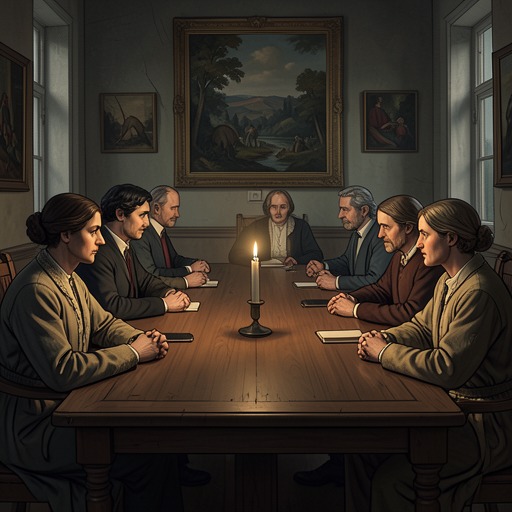
Brief Harmony and Moments of Eternity
To the LighthouseBrief Harmony and Moments of Eternity names the fragile coherence that emerges during the Ramsays’ dinner party: a roomful of people briefly feels gathered into a common world, and Mrs Ramsay senses that such instants are the substance of what endures. The scene’s force comes from its double vision. The candles, shared food, and faces create a present experience of connection, while the rippling windows and Mrs Ramsay’s awareness that the security cannot last keep change in view. Permanence is not secured by stopping time; it is glimpsed within its passing.
The Table Brought into Light
Eight candles first reveal the whole length of the table and, at its centre, a yellow-and-purple dish of fruit arranged by Rose. In the twilight it had not commanded the same attention. Under the candles it appears to Mrs Ramsay immense and deep, like a world with hills and valleys to explore, and its grapes, pears, shell, and bananas suggest a trophy brought from the sea and a mythic banquet. The ordinary centrepiece becomes, through light and concentrated looking, a landscape of imaginative possibility.
Augustus Carmichael looks at the same fruit in his own fashion, taking in one bloom and then another before withdrawing into his solitary contemplation. His manner differs from Mrs Ramsay’s, but the shared object briefly draws them into sympathy: looking together unites them. The moment does not erase their differences or establish an intimacy that lasts beyond it. Instead, the scene makes common attention itself a form of connection, achieved without requiring either observer to see exactly as the other does.
A Room Set against the Outside
As the candles are lit, the faces on both sides of the table appear closer, and the people become a party gathered around a table. The windows do not offer a clear view beyond the room; their rippling glass makes the exterior seem to waver, with things appearing to move and vanish. Inside, by contrast, there seems to be order and dry land. The contrast gives the dinner its shape: a temporary enclosure of human company set against a world that cannot be held still or seen clearly.
This change in atmosphere moves through the guests as if they had become conscious of making a party together in a hollow, on an island, with a common cause against the fluidity outside. Mrs Ramsay’s earlier uneasiness, as she waits for Paul Rayley and Minta Doyle, gives way to expectation. Lily Briscoe tries to understand the sudden exhilaration and associates it with an earlier moment on the tennis lawn, when solidity seemed to vanish and great spaces opened between people. Here, the candles, sparely furnished room, bare windows, and mask-like candlelit faces bring about a related shift. The group feels lighter, and possibility seems to open just before the latecomers enter.
Fulfilment and the Awareness of Its Limits
For Mrs Ramsay, the dinner gathers meaning from the people around her: her husband, children, and friends. While conversation continues, she feels a solemn security, as though the company’s shared presence had risen like smoke and were holding them together. The feeling does not depend on a declaration or a dramatic reconciliation. Nothing needs to be said; nothing could be said. Its coherence is apprehended in the act of sitting together, eating, listening, and attending to one another.
That fulfilment already contains its limit. Mrs Ramsay separates herself inwardly from the present even as the talk continues, thinking that this cannot last. The knowledge does not cancel her joy; it makes the moment’s temporary nature part of its meaning. Like the reflected lights in the window, the company belongs to a scene exposed to change, not a stable world beyond it. The dinner’s harmony is therefore neither a permanent resolution of the characters’ difficulties nor an illusion without value. It is a real, brief experience whose vulnerability sharpens its significance.
The Moment That Endures
Mrs Ramsay interprets the stillness around the table as evidence that some coherence and stability can shine out amid what flows, passes, and becomes spectral. She compares that resistant brightness to a ruby: not a denial of change, but a moment of clarity within it. The thought recalls a similar feeling she had experienced earlier that day, making the dinner part of a recurrence in which transient experiences disclose a sense of peace and rest.
Her conclusion, “Of such moments, she thought, the thing is made that endures,” gives the scene its central proposition. What endures is not the dinner as an uninterrupted state of happiness. It is the gathered moment itself, apprehended as meaningful even while Mrs Ramsay knows it will pass. The narrative thus holds evanescence and permanence together: the candlelit party is temporary, yet the form of attention that recognizes its coherence gives the passing instant lasting imaginative weight.